Fake

I cannot tell you what I’m thinking
Because it will hurt me more than it will hurt you
It won’t hurt me to hurt you – you understand?
I’m beyond that
I found out long ago that the heart is a predator
It has eyes that look straight ahead and measure the distance to its prey
It will not be distracted from its arcane purpose by the brain
Which it considers to be an expensive luxury

I cannot tell you how I feel
Because the detritus that has been washed down the limbic channel
Has formed an impassable coronary calculus
And nothing can get through
The impasse makes me articulate, perceptive
Because the exquisite pain it creates lends me the clarity
To see Jung beating down Loyola’s door
Which ordinarily would make me laugh – but not today

I cannot tell you how little or how much I love you
Not because my love is stinting or infinite – or somewhere in between
But because I was never given the tools to make such measurements
The mathematics of adoration I must leave to the Florentines
But yet, there is something that mollifies the synapses
Something that insinuates and suggests itself
A cognitive messenger from the expensive luxury perhaps?
You won’t like what I’m thinking. So I will not tell you.

Splat

So What Did You Expect? (Fragment from the unpublished monologue ‘Sphincteral Security’)

SplatSo what did you expect?
Were you optimistic about the prospect of love and affection? Did you really believe the door bell’s tone? Like a herald announcing the imminent arrival of your Prince? Not just some day – but today – your Prince had come. Or was that simply Purple Rain on Classic Hits releasing some of those snap-frozen procreative juices?
Just what was it you expected, eh?
Was it someone who might listen to understand? Might give more than take? Might read to you from The Sonnets? Compare you to a summery, mummery  day at the Maypole? Introduce you to The Planets? Sweet upholstery indeed.
Did you hope for joy?
An die Freude? A bit of the old Ludwig Van? Choral comfort leading you to Paradise? Blind John Milton conducting Oliver’s Army on the road to the First Republic? Let’s get metaphysical, metaphysical. Don’t want much, do you?
How much is enough? Enough is never enough, you say?
The Philosopher’s Stone? Is that it then? Base metal into precious metal? Led Zeppelin into Golden Earring? Waterloo into Red, Red Wine?
Now I see it. The Mona Lisa smirk; the Enigma Variation; the Shadow of Your…

Why didn’t you say?

Hand-Me-Down

Today a man – well an artist – told me
That
I have beautiful hands
And I thanked, I thank, him for
That

Because
He gave me cause to think of my father
Whose hands were beautiful
When they played Fats Waller
Or pointed me back to the right track

Today  I remembered
What
It is like to be a son
And I thank the artist, the man
For that.

A Song for Lorde (Rap the Critics)

I think I fit my age, I think I fit my name
If I was 17 or more –  then it wouldn’t be the same
I’ll keep Ella in the cellar – I’d rather run with Lorde
I’m suspicious of the major, prefer a minor chord

The thing about the music is it’s got its here and now
It can’t be there, it can’t be then and only knows the how
So when I write it next year, it just won’t be the same
But I think I’ll fit my age, I think I’ll fit my name

Wipe away the tears. Wipe away the tears
Wipe away the years. Wipe away the years
Not yet a woman nor a girl
The sort to give old men a thrill
You say. You say

And it’s still about the music, it’s still about how much
That less is more and just enough is better than too much
But if you’re dead against it and need someone to blame
Then here I am. I fit my age and by now you know my name

Wipe away the tears. Wipe away the fears
Wipe away the years. Wipe away the fears
Not yet a woman nor a girl
The sort to give old men a thrill
You say. You say. You say. You say

Allegro Doloroso – The Short, Sad Life of Carmen Costigan

Just recently I watched the movie, Hilary and Jackie (1998 Anand Tucker) which deals with the life of the celebrated cellist, Jacqueline du Pré. That story brought to mind a contemporary of du Pré, Carmen Costigan, whose life, accomplishments and tragic death closely mirrored those of the more famous musician.
Carmen was born in 1946 – the only child of Michael and Ysabelle Costigan. Her father had been involved with Sinn Fein, in Eire, but moved to London at the conclusion of WWII, where he owned and operated a garage business in Norwood, near to the Costigan home. Carmen’s mother, Ysabelle, was of French Moroccan extraction and had been a member of The Comédie-Française in Paris before the war. In their tidy Norwood ‘semi’, she gave acting and singing lessons to the sons and daughters of the South London middle classes.

The young Carmen prospered in this creative environment but it was clear to Ysabelle that her daughter’s real talent lay with the piano. And so, from the age of 6, until she was 14, Carmen received the best tutoring available, including a spell with the redoubtable Joyce Hatto at Crofton Grange. It was clear that Carmen was something of a prodigy and she won many accolades and prizes for her playing in the recital competitions that took place all around Britain.

In April, 1961, Hatto arranged for Carmen to give a short recital as a prelude to  her own appearance as a soloist in a concert at the prestigious Wigmore Hall in London. The whole concert was to be broadcast live on BBC radio.
The evening was a triumph and brought Carmen to national attention. She played pieces by Satie, Poulenc and Debussy with such fluidity and precision that musicologist, Denis Stevens, urged Walter Legge, who was also present, to use his influence to persuade EMI to put Carmen under contract.

Ysabelle now became Carmen’s full-time manager but the pressure of dealing with Carmen’s formal education and continuing musical tuition, agents, journalists, venue owners and EMI soon proved to be beyond her capability. Also, Carmen, an attractive teenager in the public eye, was dating a series of young men. One of these suitors was emerging jazz talent, Roy Budd, another product of the competition circuit. Budd proved to be the only fixed star in Carmen’s life as, over the next ten years, she seemingly wasted all of the talents, prospects and relationships that defined her future on that April evening in 1961.

What followed was not a steep decline. Rather, there were troughs and peaks scattered along a gradual descent. There were bouts of alcoholism punctuated by times of stability and success notably her appearance at the Albert Hall in 1966 with Jacqueline du Pré and Daniel Barenboim. And in 1967, her recording of Ravel’s Piano Concerto in G major for EMI won the coveted Gramophone Magazine’s Editors Award. But her appearances and output were becoming increasingly sporadic and her relationship with Ysabelle had all but disintegrated by 1968. Her affairs, too, were public, noisy and always disastrous. George Best, Tom Jones, David Hemmings and, briefly, Daniel Barenboim were amongst a string of lovers that provided lurid fodder for the tabloids and chat shows.

It could only end badly – and it did – with Carmen collapsing at a party for her 23rd birthday in May, 1969. Ysabelle, of course, rushed to her side and persuaded her to return home to Norwood to complete her recovery, once released from hospital some three months later.
Back with her parents, Carmen entered what was probably the most tranquil and productive period of her life. Starting with giving ‘advanced’ tuition to promising young pianists, she also began to develop her own playing and repertoire – concentrating on the classical period composers such as Bach, Mozart and Telemann. (Curiously, in the summer of 1970, Carmen spent a month at the Salisbury ashram which had attracted Peter and Abe Savage. This episode is recorded in an earlier blog Lost Treasure of the Aztecs)

By mid-1972, Carmen was fully recovered and – now 26 – better equipped to reconcile the demands of her public life with her need for a private life. It was at this time that she met Michael Stokes, son of Donald Stokes (later Baron Stokes), the Chairman of The British Leyland Motor Corporation. Michael believed himself to be something of an entrepreneur and soon persuaded Carmen to allow him to manage her career. Initially, the new arrangement bore fruit. Some well-chosen appearances on radio and television, discussing her past and the come-back; a few guest appearances at concerts and festivals – and then a performance of Mozart’s Piano Concerto No 10 for two pianos, with Daniel Barenboim in Paris in December which was widely acclaimed.

At the beginning of 1973, both HMVand Deutsche Gramaphon approached Carmen to discuss a recording contract. But Michael persuaded her to sign a special deal with British Leyland in conjunction with HMV. At that time it was not unusual for recordings, particularly of classical music, to be sponsored by private industry. Tobacco companies frequently released albums under their proprietary ‘label’. In this case, Leyland were about to launch their new family vehicle, the Austin Allegro, and Michael’s plan was to produce an album entitled ‘Allegro’, featuring Carmen.
So in June that year Carmen went into the HMV studios to record the 12 selections for the album together with the Royal Philharmonic Orchestra. As part of the publicity campaign for the album, Carmen was given the keys to a new, Series I Allegro. Michael also arranged for David Bailey to do the photography and sleeve design for the album. Carmen and the RPO completed the dozen tracks within a week and the tapes were ready for mastering. But on a wet friday night on her way back to Norwood from the studio,, Carmen was killed instantly when her Allegro skidded out of control and hit a power pole, about a mile from her home.

The media storm that followed ensured that the true tragedy of Carmen’s life and death was ignored in favour of speculation as to her state of mind, her alcoholism, her lovers, her ‘chequered history’ as the Daily Mirror put it. The album, ‘Allegro’, was canned,  as was all associated promotional material. No one at Leyland wanted to be associated with the accident. In a short while the story fizzed out and Carmen became just another 27-year-old musician that never made it to 28.

Author’s note;
Research was often difficult for this piece. However, an old friend with contacts has told me that he may be able to obtain access to some of David Bailey’s art work for ‘Allegro’. If that comes to pass, I will publish a post scriptum to this blog.

article-0-091D27B6000005DC-641_468x390

The Economics of Crime ‘Killing Them Softly’ – Film Review

I watched this movie on the weekend and it’s rather stayed with me since then. It’s exhilarating meanness is quite deliberate, I think, and lends Andrew Dominik‘s latest exploration of criminality some integrity and traction.

Set in Boston, the story follows the characters involved in the ripping off of a mob-protected poker game. Driver (Richard Jenkins) is the cautious intermediary sent by the Mafia to look into things and restore order. He enlists the aid of Jackie Cogan (Brad Pitt), a cynical enforcer who has scant regard for the politicians fighting out the 2008 election that is the movie’s backdrop. Cogan tells Driver that the game’s proprietor, Markie Trattman (Ray Liotta) must necessarily be the first victim of the reprisals. Markie’s innocence or guilt is irrelevant. The punters must have confidence in the game and the mob’s ability to maintain security. There’s a recession and illegal gambling is also subject to the same financial crisis that shredded Wall Street in the autumn of 2008. Perception and market confidence is everything.

And so Dominik takes us into Cogan’s Dantesque world. We accompany the two young crooks, Frankie and Russell, whose everyday attitude to serious crime is eerily instructive, as they steal the gambling stakes in an unbearably tense scene that had me leaning anxiously forward, fearing the worst.
imagesCAE7D2T9
We meet ‘Squirrel’ (Vincent Curatola) who plans the heist and identifies Markie as a ready-made fall guy. We encounter Mickey Fallon (James Gandolfini), a played out contract killer, more concerned with excessive self-indulgence than helping Cogan. The mean streets of Boston are populated by the venal and the desperate.

What Dominik is showing us, through his fine script and direction, is similar to the analogy drawn by Coppola in The Godfather; that crime has a parallel dynamic to business; that its mores and rules are identical; that its outcomes are inextricably linked to the Share Price Index and the value of the greenback. As such, ‘Killing Them Softly’ is a convincing companion piece to ‘Margin Call’ which I reviewed last year In Wise Blood.

As for the performances – I especially liked Scoot McNairy and Ben Mendelsohn as the two young hoods. They bring a curious, quotidian flavour to their portrayals that sits well inside the director’s bleak vision of routine wretchedness. Everyone else is fine. Brad Pitt is becoming a dab hand at psychotics; Achilles, Jesse James and now Jackie Cogan. He fills out his character with some recognisable quirks. He doesn’t like to get up close and personal with his victims because he can’t handle their anguish. He prefers distance. He bitches about politicians, the lack of community and about being short-changed by Driver. He provides the movie’s telling epilogue – ‘America’s not a country….it’s a business.’

Author’s Note
New Zealander, Andrew Dominik has previously directed ‘Chopper‘ and ‘The Assassination of Jesse James….’. The movie reviewed here is based on George V Higgins’ 1974 novel, Cogan’s Trade. It would seem that Dominik is well on his way to auteur status and I look forward to his next exposition on the state of the criminal union.

Lost Treasure of the Aztecs

During the past few weeks I’ve been trying to make some sense of all the LPs, CDs and other musical stuff that fills up our apartment. This has been tried before – but this time I’m really, really serious about it. Okay?
Previous attempts to create order have always yielded some long-forgotten gem (or clunker) that might bring on nostalgia, revulsion or even puzzlement. Last night, foraging in some old cardboard boxes I made a truly amazing discovery. In amongst some long discarded 70s party albums, like a diamond in some dog shit, there it was.
A promotional copy of  ‘Blondel’s Last Hurrah’ by The Aztecs seemed to levitate magically, like the Holy Grail, out of the box and into my trembling hand.
_bicicleta_detail_image

Peter and Abe Savage were brothers from Bristol. In the 60s they had been in the vanguard of the folk rock movement as Gog and Magog and gained notoriety with their stage show, described as ‘bacchanalian‘ by the New Musical Express. Their success heralded the now familiar steep decline fuelled by an excess of just about anything and everything. Ralph J Gleason wrote a famous faux obituary for them in the December 1969 edition of Rolling Stone.
But the music community gathered around them and the brothers spent a year getting clean at an ashram near Salisbury. And this is where legendary producer, Mike Vernon, had found them in the spring of 1971. Vernon had worked with the Savage brothers at Decca in the 60s and was now looking for an act to headline his own, new, Blue Horizon label.
Peter had been working on a concept album built around a mediaeval song cycle of roundelays and madrigals,, loosely based on the story of the minstrel Blondel‘s search for the imprisoned King Richard I – ‘The Lionheart’. Vernon was enthusiastic for the project and in short order the brothers were back in the studio, as The Aztecs, with a host of luminaries from the British rock scene, Eric Clapton and a young Christine McVie amongst them.
Apparently, the first six tracks were recorded without a hitch in 2 days. But when the brothers’ erstwhile manager ‘Campy’ Campion, arrived uninvited, the situation disintegrated rapidly. Campion had only recently been released from prison where he had served time for supplying prohibited substances. Vernon tried to intervene but Campion had a Svengali-like hold over the Savage brothers and within hours the situation had deteriorated to the point where most of the other musicians and technicians simply left the studio, never to return.
To his credit, Vernon stayed on and, augmenting the six tracks already completed with some earlier demo tapes, he patched together an album of 10 tracks lasting about 43 minutes.
The album only ever appeared in promotional form because the various legal complexities and court actions that emerged following the debacle in the Blue Horizon studios injuncted a commercial release. The Savage brothers returned to Bristol and developed a plastic extrusion plant – which they still own.
Listening to the album again last night was an odd experience. The music has certainly dated but its intensity, particularly the title track, remains undiminished. Abe’s sole contribution, ‘King John in the Wash’ made me laugh a little. It made me think of Pentangle fed through a Led Zeppelin strainer somehow.
But I’m pleased to have rediscovered The Aztecs. They hold a special place in the pantheon of hippy icons and, best of all, the rare and vintage record site tells me that ‘Blondel’s Last Hurrah’ will pay for a week in Queenstown.

1971%20Two%20Hippies%20-%20Final%204-12-2009%20550

Author’s Note
The (apocryphal) explanation for the name ‘The Aztecs’ lies in Peter’s amusement at his brother’s discomfort following a trip to Mexico – where it is said that Abe suffered from a bout of Montezuma’s Revenge.


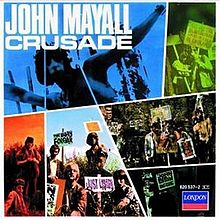
The Triumph of Everyman. John Mayall – Crusade (1967)

I have to say right off that I’ve neglected John Mayall. Shunned him, forgotten about him, flicked past his discs, undervalued him. I’ve taken him for granted. Yet Mayall was as much a part of my discovery of blues music as, say, Howling Wolf, Muddy Waters or Alexis Korner.  I need to take stock.
I saw the Bluesbreakers play often in the London of the mid-sixties. In their first incarnation they’d struggled to get a foothold. I didn’t think that John was much of a frontman. But with the arrival of Eric Clapton in 1965, things changed for the better. The Bluesbreakers album was hugely successful and is now considered a classic.
In those days, line-ups were fluid, to say the least – and between 1965 and early 1967, Clapton and Peter Green job-shared with the Bluesbreakers. Green was on hand to record A Hard Road, another acknowledged classic. But by May, 1967, both men had left – Clapton to form Cream and Green to start up Fleetwood Mac.
The vacancy was filled by 18-year-old (soon to be very , very famous) Mick Taylor. And it’s Taylor who plays lead on Crusade. John McVie (probably flitting between the Mac and Mayall) is on bass, Keef Hartley on drums, Chris Mercer and Rip Kant on tenor and baritone respectively. Mayall plays everything else and does the vocals. The album, recorded in 2 days in July, 1967 at Decca studios, is a cracker.
220px-Crusade_(John_Mayall_album)_coverart
The original mono album has 12 tracks, some of them penned by Mayall, some of them covers. All of the material is strong and repays repeated listening. In particular, Mayall’s The Death of J B Lenoir stays in the mind. Its haunting piano line and Mayall’s impassioned vocal, as he mourns his hero, creates a fitting elegy to a great bluesman.
Of note, too, is Snowy Wood, an instrumental written by Mayall and Taylor, that showcases Taylor’s playing.(I’ve been listening to some Buddy Guy recordings from when Guy was in his pomp. It’s fair to say that there are similarities of brilliance in the styles of the two men)
What the album does, is allow Mayall to stretch out, show his range and enjoy himself. Everything from jazz-tinged or funk-driven through to 12 bar straight ahead Chicago is here. It really is a tremendous listen.
So – there it is. I should have listened harder the first time around. But I’m making up for it this time around. John is approaching 80 and he’s still touring  – still playing the blues.
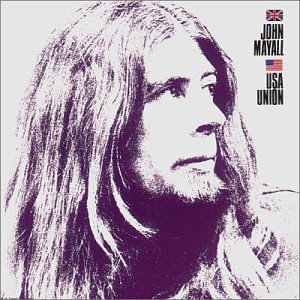
John_Mayall_D_USA_Union

Author’s Note
There is an expanded version of this album available on CD. It contains a further 10 tracks from the 1969 compilation Thru the Years. I believe that Hughie Flint plays drums on some of these tracks.

Cinéma vérité – Heart and Darkness. ‘Overlord’ – A Movie Review

Overlord is a black and white film made in 1975 by Stuart Cooper. It blends live action with documentary footage sourced from thousands of hours of film in the Imperial War Museum archives. The story begins in the final years of WWII, in England, and follows the fortunes of Tom, from his call-up and training to his D-Day arrival on the Normandy beaches.
overlord

Although the movie won the Silver Bear at the Berlin Film Festival, it received only a very limited release and has only recently been re-mastered onto DVD and gained the distribution and recognition it undoubtedly deserves.
I watched it a few days ago and the story and its characters have clung to me since then. It seems to me that the seamless union of documentary footage and transparent performance has produced a tender tragedy that reveals moments of truth about the human condition. The uncertainty of conflict accelerates both process and outcomes. Intimacies are exchanged within hours of an acquaintance being made. Profound realisations are made because fate is only the pull of a trigger away.
Tom is a decent young man. He is accepting of his harsh induction into Army life and soon befriends Arthur, a street-wise cockney and a (unnamed) young woman he meets at a dance. He shares with them his premonitions of death in the coming invasion. Yet he also writes to his parents about his pet spaniel’s delivery of a litter. There is a disarming knowingness about Tom – a sweet gravitas that is neither morbid nor cloying. It is what drives this story makes it compelling and ensures that its artlessness grants this production a good measure of truth.
Instrumental in achieving this work of art, are director, Stuart Cooper and cinematographer, John Alcott. Alcott, who was a frequent collaborator with Stanley Kubrick, was able to find and use some vintage, untreated German lenses and old Kodak stock so that his live footage resembled more closely the archival material. The resulting fusion is brilliantly achieved and creates an elliptical history in which the young leads, Brian Stimer (Tom) and Nicholas Ball (Arthur) exist both before the film starts and after it has concluded.
I recommend this fine movie to you without reservation.

imagesCA1MQ92T

61 – 59

Here lies the body politic
Left murdered in a ditch
Stabbed by Key’s pimp
Dismembered by his bitch

Author’s note
The New Zealand International Convention Centre Bill
received its first reading in the House today. The Speaker had ruled that the first reading would be the subject of a conscience vote. The Prime Minister ordered his members to be subject to the whip and ACT and Peter Dunne (Independent) fell into line thus carrying the day for the government.